Why Does Your Baby Spit Up So Much?
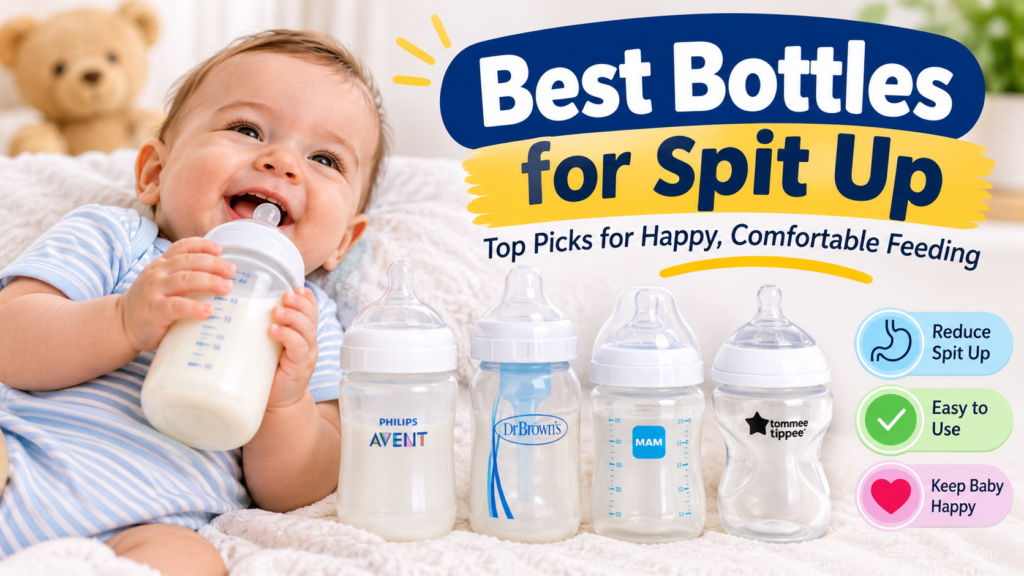
If you’re constantly changing your baby’s clothes, cleaning milk stains, and keeping burp cloths within arm’s reach, you’re probably familiar with how frustrating frequent spit-up can be. Although it’s common for babies to spit up after feeding, dealing with it several times a day can leave parents wondering whether their feeding routine or bottle choice needs to change. Finding the best bottles for spit up may help make feeding more comfortable by supporting better milk flow and reducing the amount of air some babies swallow.
Spit-up often happens because a baby’s digestive system is still developing. The muscle that keeps stomach contents from flowing back into the esophagus is not yet fully mature, making it easier for milk to come back up after feeding. Fast-flow nipples, swallowing excess air, feeding too quickly, and overfeeding may also contribute to feeding discomfort or more noticeable spit-up.
This is where choosing an appropriate baby bottle can make a difference. Many anti-colic bottles feature specialized venting systems designed to manage air intake during feeding. Others offer slow-flow nipples, carefully designed nipple shapes, or feeding systems intended to support a comfortable latch. While these features may help some babies, it’s important to understand that no bottle can guarantee an end to spit-up or treat an underlying reflux condition.
With so many options available, choosing the right bottle can quickly become overwhelming. Should you choose Dr. Brown’s internal vent system, Philips Avent’s AirFree vent, or a breast-like nipple design from Lansinoh or Tommee Tippee? And is an expensive anti-colic bottle really worth the investment?
In this guide, we’ll compare seven popular baby bottles, examining their features, benefits, drawbacks, prices, customer ratings, and real-world usability. We’ll also explore what makes each bottle different, which options may suit newborns and breastfed babies, and what to consider when comparing cleaning requirements, nipple flow, bottle materials, and long-term value.
Whether you’re a first-time parent, breastfeeding and introducing bottles, or simply looking for a more comfortable feeding experience, this guide will help you make a more informed decision.
Our goal is simple: Help you find a bottle that suits your baby’s feeding needs, makes everyday feeding more manageable, and gives you greater confidence in your choice.
Remember: Occasional spit-up is generally normal in infants. However, persistent vomiting, poor weight gain, blood or green vomit, breathing difficulties, or other concerning symptoms warrant medical attention. Always consult your pediatrician if you’re worried about your baby’s symptoms.
2. Quick Comparison: Best Bottles for Spit Up at a Glance
Not every baby needs the same type of bottle. Some babies do better with a specialized anti-colic venting system, while others benefit more from a slower nipple flow or a nipple shape that supports a comfortable latch.
The following comparison highlights seven bottles worth considering, along with the type of feeding need each one addresses.
| Baby Bottle | Best For | Price Guide |
|---|---|---|
| Dr. Brown’s Options+ | Best overall anti-colic design | Varies by size and pack |
| Philips Avent AirFree | Specialized air management | Varies by pack |
| Tommee Tippee Advanced | Dedicated anti-colic system | Varies by pack |
| MAM Easy Start | Convenient sterilization | Varies by pack |
| Lansinoh NaturalWave | Breastfed babies | Varies by pack |
| Evenflo Balance+ | Budget-conscious parents | Varies by pack |
| NUK Perfect Match | Alternative nipple design | Varies by pack |
Prices, availability, and Amazon ratings can change by seller, bottle capacity, and pack size. Check the exact Amazon listing before purchasing. We have not independently verified live Amazon ratings or review counts for all seven models, so none are invented or presented as confirmed Amazon statistics.
3. Our Top Picks: The 7 Best Bottles for Spit Up
Choosing a bottle for a baby who frequently spits up involves more than looking for an anti-colic label. You should consider how the bottle manages air, how quickly milk flows, whether your baby accepts its nipple, and how much effort cleaning requires.
Here are seven options with different designs and advantages.
3.1 Dr. Brown’s Natural Flow Anti-Colic Options+ Baby Bottle – Best Overall
Product overview
The Dr. Brown’s Natural Flow Options+ is one of the most recognizable options for parents looking for a bottle specifically designed to manage air intake during feeding. Its standout feature is an internal vent system that separates air from milk as the baby drinks.
Unlike conventional bottles that rely on a simple nipple and bottle opening, this design uses a vent insert and reservoir to direct air away from the milk. The manufacturer says this system helps reduce air bubbles and supports a more consistent feeding experience.
For babies who gulp milk, swallow noticeable amounts of air, or experience gas alongside frequent spit-up, this design may be worth trying. However, it’s important to remember that reducing swallowed air does not necessarily prevent normal infant reflux.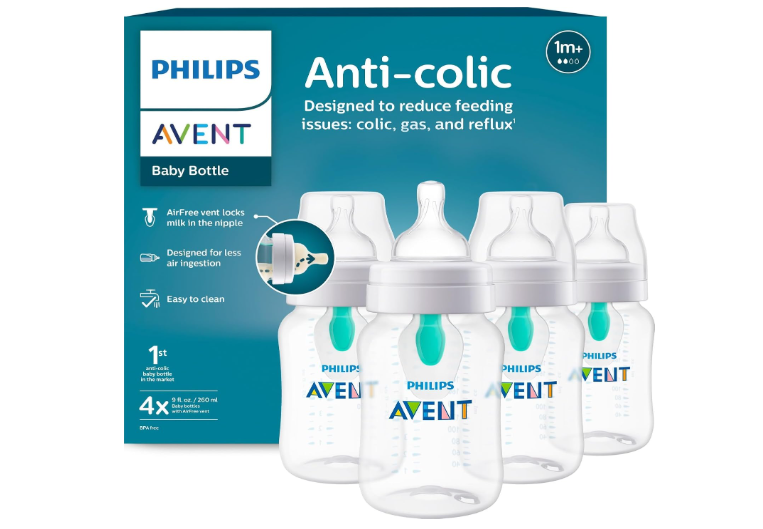
Price: The manufacturer’s US website lists individual bottle configurations around $8.99–$9.99, depending on the model. Prices for multipacks and Amazon listings vary.
Dr. Brown’s+1
Key features and benefits
-
Internal anti-colic vent: Directs air through a separate pathway rather than allowing it to mix freely with milk.
-
Slow-flow nipple: The standard Level 1 nipple is designed for slower milk delivery.
-
Consistent milk flow: The vent system is intended to support feeding without excessive vacuum buildup.
-
Removable vent: The Options+ design allows parents to remove the vent as their baby’s feeding develops.
-
BPA-free construction: The bottle is made without BPA.
-
Different capacities: Available in smaller and larger sizes, with different configurations.
Pros
-
Specialized internal venting system.
-
Designed to reduce swallowed air during feeding.
-
Multiple nipple-flow options.
-
Available in narrow and wide-neck versions.
-
Replacement nipples and vent components are available.
Cons
-
More components mean more cleaning and assembly.
-
Internal vent parts can be inconvenient during nighttime feeds.
-
Some babies may not prefer the nipple shape.
-
Replacement parts can add to long-term costs.
Amazon customer ratings and reviews
Check the current Amazon listing for the exact Options+ bottle size and configuration. Pay particular attention to recent verified-purchase reviews discussing leakage, cleaning difficulty, nipple acceptance, and whether parents noticed changes in feeding comfort.
Don’t combine reviews from glass, narrow-neck, and wide-neck versions when evaluating a specific listing.
Why it’s a good choice
Dr. Brown’s stands out because its internal venting system is specifically designed to manage air during feeding. Parents who want to try a bottle with a dedicated air-management mechanism may find it a useful starting point.
Who should buy it?
-
Parents whose babies gulp air while drinking.
-
Families looking for a specialized anti-colic bottle.
-
Parents who don’t mind cleaning several bottle components.
-
Caregivers who want different nipple-flow options.
Our verdict: Dr. Brown’s Options+ is a strong first bottle to consider if managing swallowed air is your primary concern. Its main trade-off is the additional cleaning involved.
3.2 Philips Avent Anti-Colic Bottle with AirFree Vent – Best for Specialized Air Management
Product overview
The Philips Avent Anti-Colic Bottle with AirFree Vent offers a different approach to managing air during bottle-feeding.
Its AirFree insert is designed to keep the nipple filled with milk, even when the bottle is held more horizontally. This can help parents maintain a feeding position that supports controlled milk delivery.
The design is particularly interesting for babies who struggle with feeding coordination or appear to gulp air during bottle-feeding. Rather than using a long internal vent tube like Dr. Brown’s, Philips Avent uses a specialized insert inside the bottle.
The AirFree insert can be removed when parents prefer to use the bottle without it, subject to the manufacturer’s instructions.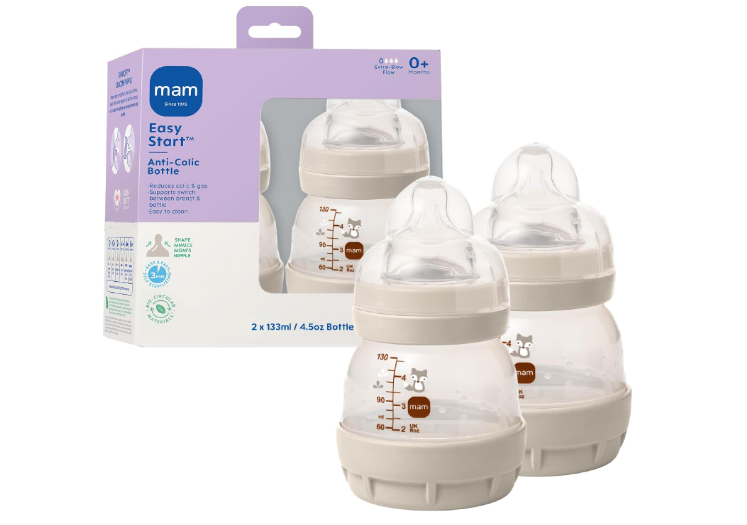
Price: $13.24.
Key features and benefits
-
AirFree vent insert: Designed to keep the nipple filled with milk.
-
Feeding flexibility: Supports feeding with the bottle held at a more horizontal angle.
-
Wide-neck construction: Makes filling and cleaning relatively convenient.
-
Anti-colic design: Intended to help reduce air swallowing.
-
Removable insert: Gives parents flexibility in how they use the bottle.
-
Multiple sizes: Different capacities accommodate changing feeding volumes.
Pros
-
Distinctive AirFree insert.
-
Relatively simple bottle design.
-
Wide opening for easier filling.
-
Designed to support controlled feeding.
-
Fewer separate internal components than some traditional vented bottles.
Cons
-
The insert must be positioned correctly.
-
Some babies may prefer a different nipple shape.
-
Parents need to learn the correct assembly.
-
It cannot guarantee reduced reflux or spit-up.
Amazon customer ratings and reviews
Check the exact Philips Avent AirFree listing rather than reviews for standard Philips Avent Natural Response or Anti-Colic bottles. These products have different feeding designs.
Look for customer feedback about insert placement, leakage, nipple acceptance, and cleaning.
Why it’s a good choice
The AirFree insert provides a distinctive way to manage air without requiring the more elaborate internal vent assembly found in certain competing bottles.
Who should buy it?
-
Parents who want a specialized air-management insert.
-
Families looking for a relatively straightforward bottle.
-
Babies who seem to gulp air during feeding.
-
Caregivers who want to experiment with different bottle designs.
Our verdict: Philips Avent AirFree is worth considering if you want an alternative to traditional internal vent systems. Its main advantage is the specialized insert, although proper assembly and positioning are important.
3.3 Tommee Tippee Advanced Anti-Colic Baby Bottle – Best Dedicated Anti-Colic System
Product overview
The Tommee Tippee Advanced Anti-Colic Baby Bottle is designed for parents who want a bottle with a dedicated air-management system and a soft, breast-like silicone nipple.
Its specialized venting system is designed to help reduce the amount of air swallowed during feeding. Depending on the version, the system includes a vented tube and other components that help direct air away from the milk.
The bottle also features a flexible silicone nipple intended to support a natural-feeling latch. This may appeal to breastfeeding families who are introducing occasional bottle-feeding.
One important detail: Tommee Tippee offers multiple bottle ranges, including Advanced Anti-Colic and Natural Start. They are not interchangeable products, so check the model name before purchasing.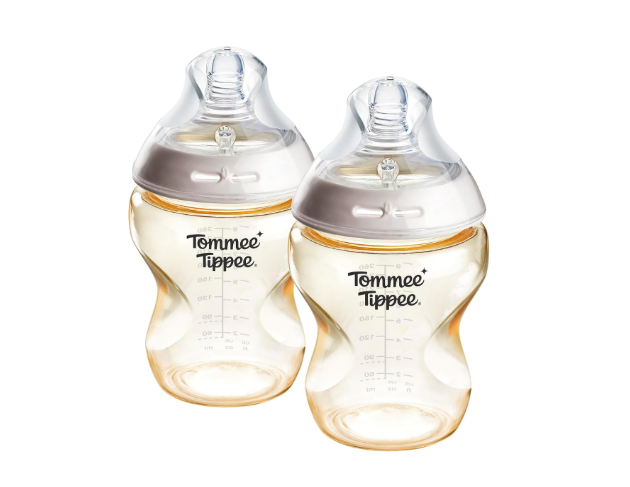
Price: $29.99.
Key features and benefits
-
Dedicated anti-colic venting system.
-
Soft silicone nipple.
-
Breast-like nipple design.
-
Different nipple-flow options.
-
Multiple bottle capacities.
-
Designed with feeding comfort in mind.
Pros
-
Specialized venting technology.
-
Soft nipple material.
-
Suitable for parents exploring combination feeding.
-
Multiple bottle sizes.
-
Alternative design to Dr. Brown’s and Philips Avent.
Cons
-
Additional components require regular cleaning.
-
Replacement parts may increase long-term costs.
-
Some babies may not accept the nipple.
-
Correct assembly is important.
Amazon customer ratings and reviews
Look for reviews of the exact Advanced Anti-Colic model. Pay attention to feedback about the vent system, cleaning, leakage, and nipple durability.
Do not use the customer rating of the Natural Start model as a substitute for the Advanced Anti-Colic rating.
Why it’s a good choice
This bottle gives parents another dedicated anti-colic system to compare. Its combination of specialized ventilation and a soft silicone nipple makes it worth considering when a conventional bottle isn’t working well.
Who should buy it?
-
Parents seeking a dedicated anti-colic bottle.
-
Families combining breastfeeding and bottle-feeding.
-
Babies who accept soft silicone nipples.
-
Caregivers willing to clean additional components.
Our verdict: Tommee Tippee Advanced Anti-Colic is a worthwhile alternative for parents who want to compare venting systems and nipple designs before choosing a bottle.
3.4 MAM Easy Start Anti-Colic Baby Bottle – Best for Convenient Sterilization
Product overview
The MAM Easy Start Anti-Colic Baby Bottle combines a ventilated bottle base with a design intended to make everyday cleaning and sterilization more convenient.
Unlike bottles that rely on a traditional internal vent tube, MAM uses a ventilated base that allows air to enter through the bottom of the bottle. The manufacturer designed this system to help reduce air bubbles during feeding.
Its most distinctive convenience feature is its self-sterilizing function. Compatible MAM bottles can be sterilized in a microwave using the manufacturer’s specific instructions, which can be useful for families who want an alternative to a separate electric sterilizer.
The bottle also has a wide opening, soft silicone nipple, and multiple capacity options.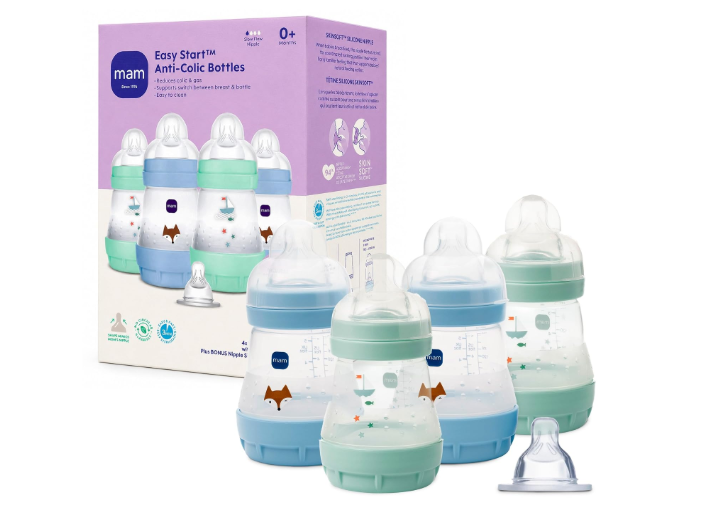
Price: $44.99.
Key features and benefits
-
Ventilated base: Designed to reduce air bubbles in milk.
-
Self-sterilizing functionality: Supports microwave sterilization when the manufacturer’s instructions are followed.
-
Soft silicone nipple: Designed for a comfortable feeding experience.
-
Wide opening: Makes filling and cleaning easier.
-
Multiple sizes: Suitable for different feeding stages.
-
Removable base: Allows access to the ventilation components for cleaning.
Pros
-
Convenient self-sterilizing feature.
-
Ventilated base design.
-
Wide opening.
-
Soft silicone nipple.
-
Different bottle capacities available.
Cons
-
Multiple components require assembly.
-
Microwave sterilization requires careful instruction-following.
-
Not all babies accept the same nipple shape.
-
Replacement components may add to the overall cost.
Amazon customer ratings and reviews
Check the exact MAM Easy Start model and pack size on Amazon. Look for feedback about the base seal, leakage, sterilization convenience, and nipple acceptance.
Why it’s a good choice
MAM combines an anti-colic feeding design with a useful sterilization feature. For parents managing multiple daily feeds, reducing the hassle of sterilization can be a meaningful advantage.
Who should buy it?
-
Parents who value convenient sterilization.
-
Families looking for a ventilated-base bottle.
-
Caregivers who prefer wide-neck bottles.
-
Parents seeking an alternative to internal vent tubes.
Our verdict: MAM Easy Start is a practical choice for parents who want feeding-related features alongside convenient bottle maintenance.
3.5 Lansinoh Anti-Colic Baby Bottle with NaturalWave Nipple – Best for Breastfed Babies
Product overview
The Lansinoh Anti-Colic Baby Bottle with NaturalWave Nipple is especially appealing to parents who breastfeed and want to introduce expressed breast milk in a bottle.
Its NaturalWave nipple is designed to encourage the tongue and mouth movements associated with breastfeeding. The gradual slope and soft silicone construction aim to support a deeper latch and a comfortable feeding experience.
The bottle also incorporates an anti-colic air ventilation system intended to help manage air intake during feeding.
For breastfeeding parents, this combination can be useful because bottle acceptance and nipple preference are often just as important as the venting system.
However, no bottle can guarantee that a baby will maintain the same feeding behavior between breast and bottle. Every infant responds differently.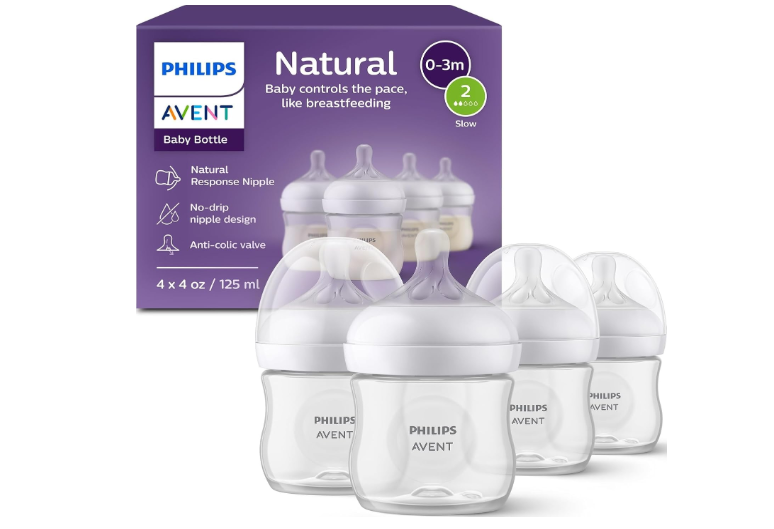
Price:
.
Key features and benefits
-
NaturalWave nipple: Designed to support natural tongue movement.
-
Anti-colic ventilation: Helps manage air during feeding.
-
Soft silicone: Provides a flexible nipple feel.
-
Wide-neck construction: Supports convenient filling.
-
Combination-feeding design: Intended to make breast-to-bottle transitions easier.
-
Different sizes: Available in configurations for different feeding needs.
Pros
-
Designed with breastfeeding compatibility in mind.
-
Soft silicone nipple.
-
Dedicated air ventilation.
-
Useful for expressing and feeding breast milk.
-
Relatively straightforward bottle shape.
Cons
-
Some babies may need time to accept the nipple.
-
Slow-flow nipple availability should be checked separately.
-
Some parents report leakage concerns with bottle components.
-
Ventilation does not guarantee reduced spit-up.
Amazon customer ratings and reviews
Check the exact Lansinoh Anti-Colic listing. Focus on reviews from parents who use both breastfeeding and bottle-feeding.
Useful review topics include nipple acceptance, latch, leakage, cleaning, and milk-flow consistency.
Why it’s a good choice
Lansinoh offers a combination of breastfeeding-oriented nipple design and anti-colic ventilation. This makes it particularly relevant to parents who want to introduce bottles without overlooking their baby’s existing feeding preferences.
Who should buy it?
-
Breastfeeding parents introducing expressed milk.
-
Families combining breast and bottle feeding.
-
Babies who prefer softer silicone nipples.
-
Parents looking for an alternative nipple design.
Our verdict: Lansinoh is a strong candidate for combination-feeding families, especially when nipple acceptance is a major consideration.
3.6 Evenflo Balance+ Wide Neck Baby Bottle – Best Budget-Friendly Alternative
Product overview
The Evenflo Balance+ Wide Neck Baby Bottle takes a somewhat different approach from the dedicated anti-colic bottles in this guide.
Rather than relying on an elaborate internal venting system, its main selling point is its nipple design. The gradually sloped nipple is intended to support a deeper latch and allow babies to draw more of the nipple into their mouths.
This can be helpful for parents who want to focus on feeding mechanics and nipple compatibility rather than purchasing a bottle with multiple specialized components.
Evenflo Balance+ is available in different configurations, including plastic and glass versions in some markets. Check the exact product before ordering.
It is important to understand that this bottle should not be considered equivalent to a specialized anti-colic bottle. Its appeal is primarily its feeding-oriented nipple design and potentially more economical price.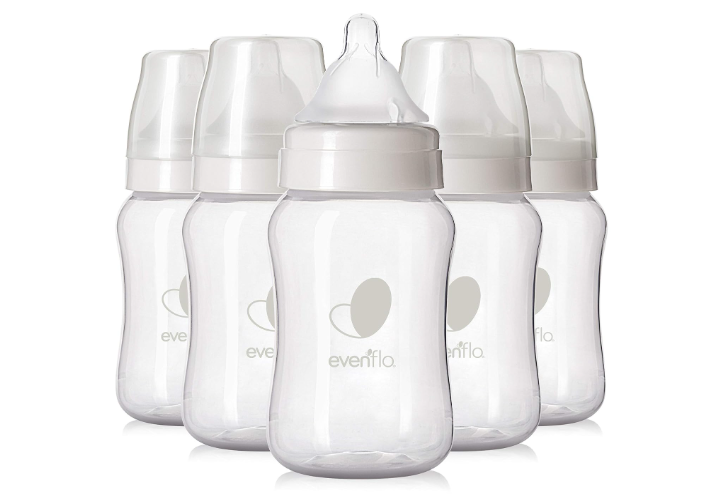
Price: $19.89.
Key features and benefits
-
Wide-neck bottle design.
-
Gradually sloped silicone nipple.
-
Different nipple-flow options.
-
Plastic and glass configurations, depending on availability.
-
Simple bottle construction.
-
Designed to support a comfortable latch.
Pros
-
Potentially affordable.
-
Simple bottle design.
-
Wide-neck opening.
-
Different material options.
-
Useful for parents comparing nipple shapes.
Cons
-
Does not offer the same specialized internal venting as Dr. Brown’s.
-
May not suit babies who need a dedicated air-management design.
-
Nipple acceptance varies.
-
Specific configurations may be difficult to find.
Amazon customer ratings and reviews
Verify the rating for the exact Balance+ model and material. Pay particular attention to reviews about nipple acceptance, bottle durability, cleaning, and leakage.
Why it’s a good choice
Not every family needs a complex anti-colic system. Evenflo Balance+ offers an alternative for parents who want to explore nipple shape, feeding comfort, and affordability.
Who should buy it?
-
Budget-conscious parents.
-
Families who prefer simple bottle designs.
-
Parents comparing wide-neck nipple shapes.
-
Caregivers who want glass or plastic options.
Our verdict: Evenflo Balance+ is worth considering as an affordable feeding alternative, but parents specifically seeking specialized anti-colic ventilation may prefer one of the other bottles.
3.7 NUK Perfect Match Baby Bottle – Best Alternative for Newborn Feeding
Product overview
The NUK Perfect Match Baby Bottle is another option for parents comparing bottle shapes and nipple designs.
Its soft, flexible silicone nipple is designed to adapt to the baby’s mouth. This can be appealing for newborns and younger infants who are still developing their bottle-feeding coordination.
One advantage of considering NUK is that it gives parents another nipple style to compare when their baby refuses a particular bottle.
However, parents should be careful not to assume that every NUK bottle includes the same anti-colic features. Product ranges and designs vary, so verify the exact model and its ventilation features before purchasing.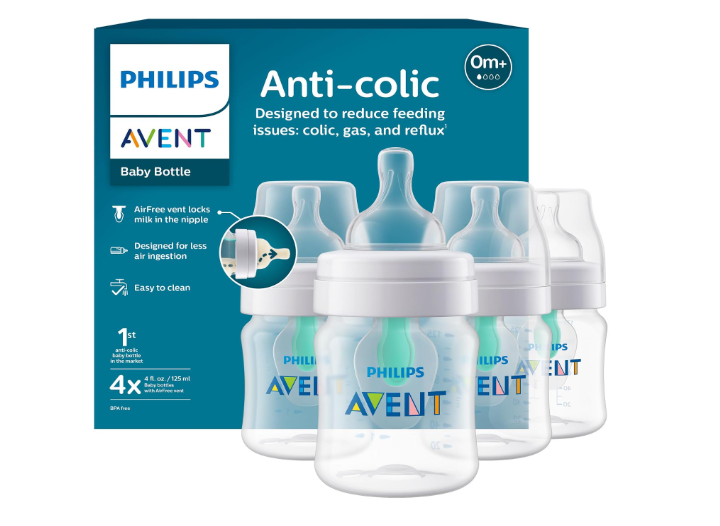
Price:$23.95.
Key features and benefits
-
Soft silicone nipple.
-
Flexible nipple design.
-
Different bottle capacities.
-
Nipple-flow options depending on model.
-
Designed for infant feeding.
-
Alternative to traditional narrow-neck nipple shapes.
Pros
-
Another nipple shape to try.
-
Soft silicone construction.
-
Newborn-oriented options.
-
Different capacities.
-
Useful for babies who reject other nipple styles.
Cons
-
Not every version has the same anti-colic system.
-
Nipple preference differs between babies.
-
Flow suitability must be checked.
-
Availability varies by market.
Amazon customer ratings and reviews
Check the exact Perfect Match model and confirm whether the listing includes an anti-colic vent. Review customer feedback about nipple acceptance, milk flow, cleaning, and leakage.
Why it’s a good choice
NUK offers parents another option when nipple compatibility is the main concern. A baby who struggles with one bottle shape may respond better to another design.
Who should buy it?
-
Parents comparing different nipple styles.
-
Families looking for a newborn feeding bottle.
-
Babies who reject other bottle designs.
-
Caregivers who want to test different feeding options.
Our verdict: NUK Perfect Match is best viewed as an alternative nipple-design option rather than a guaranteed reflux solution. Confirm the exact bottle features before choosing it for spit-up concerns.
4. Detailed Comparison: Which Anti-Spit-Up Bottle Should You Choose?
After looking at individual products, it’s useful to compare them according to the features that matter most during everyday feeding.
4.1 Best Overall vs. Best Specialized Venting System
Dr. Brown’s Options+ and Philips Avent AirFree are two particularly interesting options because they use different approaches to managing air.
Dr. Brown’s Options+
-
Uses an internal vent system.
-
Separates air from milk during feeding.
-
Offers different nipple-flow levels.
-
Has more components to clean.
Philips Avent AirFree
-
Uses a specialized AirFree insert.
-
Designed to keep the nipple filled with milk.
-
Has a relatively straightforward overall design.
Which should you choose?
Choose Dr. Brown’s if you want a dedicated internal vent system and don’t mind additional cleaning. Consider Philips Avent if you prefer an AirFree insert and want a different approach to air management.
Neither bottle is guaranteed to reduce reflux-related spit-up.
4.2 Best Bottles for Breastfed Babies
For parents who breastfeed and introduce bottles, nipple acceptance can be a major deciding factor.
Three options worth comparing are:
-
Lansinoh NaturalWave: Designed to encourage natural tongue movement and a deeper latch.
-
Tommee Tippee Advanced Anti-Colic: Combines a specialized vent system with a soft silicone nipple.
-
MAM Easy Start: Offers a soft silicone nipple and ventilated base.
When choosing, consider whether your baby accepts the nipple comfortably, can maintain a good latch, and feeds without coughing, gulping, or struggling.
A breast-like nipple does not automatically guarantee breastfeeding compatibility. Your baby’s individual feeding preferences matter more than marketing descriptions.
4.3 Best Budget vs. Premium Options
A higher-priced bottle isn’t necessarily more effective for your baby.
When comparing prices, consider:
-
Cost per bottle rather than the total multipack price.
-
Whether additional vents or inserts are included.
-
Replacement nipple prices.
-
Availability of spare components.
-
Cleaning accessories.
-
Whether the bottle can be used as your baby grows.
Evenflo Balance+ may appeal to families seeking a simpler bottle, while Dr. Brown’s and other specialized systems offer additional air-management components.
Money-saving tip: Instead of purchasing a large multipack immediately, consider testing one bottle first. This helps you avoid spending money on a design your baby may not accept.
4.4 Which Bottle Is Easiest to Clean?
Cleaning convenience can make a surprising difference, especially when you’re preparing several feeds each day.
| Bottle | Cleaning Consideration | Main Trade-Off |
|---|---|---|
| Dr. Brown’s Options+ | Internal vent components | More detailed cleaning |
| Philips Avent AirFree | Removable insert | Correct positioning needed |
| Tommee Tippee Advanced | Venting components | Additional assembly |
| MAM Easy Start | Removable ventilated base | Several parts to clean |
| Lansinoh NaturalWave | Ventilation components | Requires regular inspection |
| Evenflo Balance+ | Relatively simple construction | Fewer specialized features |
| NUK Perfect Match | Check exact model | Depends on configuration |
Always follow the manufacturer’s washing and sterilization instructions. A dishwasher-safe label does not mean every component can be cleaned in every dishwasher cycle.
4.5 Best Bottle by Baby’s Age
A bottle that works for a newborn may not remain the most convenient choice as feeding volumes and skills develop.
Newborns (0–1 month)
Prioritize:
-
Suitable slow-flow nipples.
-
Smaller bottle capacities.
-
Comfortable nipple fit.
-
Easy-to-monitor feeding.
Babies aged 1–3 months
Consider:
-
Continued slow-flow suitability.
-
Feeding coordination.
-
Signs of excessive gulping.
-
Bottle acceptance.
Babies aged 3–6 months
Reassess:
-
Whether the current nipple flow remains appropriate.
-
Whether a larger bottle capacity is practical.
-
Whether the baby feeds comfortably.
Babies older than 6 months
Consider:
-
Developmental feeding changes.
-
Age-appropriate bottle options.
-
The manufacturer’s recommendations.
-
Your pediatrician’s guidance if feeding problems continue.
Don’t automatically increase nipple flow just because your baby has reached a certain age. The correct flow depends on the baby’s feeding skills and individual needs.
5. What Causes Babies to Spit Up After Bottle-Feeding?
Before choosing a new bottle, it helps to understand why babies spit up in the first place. Although frequent spit-up can be messy and frustrating, it isn’t always a sign that something is wrong.
In many cases, it happens because an infant’s digestive system is still developing. However, feeding habits, nipple flow, and swallowed air can also influence how comfortable a baby feels after feeding.
5.1 Immature Digestive Systems
One of the most common reasons babies spit up is that the muscle between the esophagus and stomach is still developing.
This muscle, known as the lower esophageal sphincter, normally helps keep stomach contents from flowing backward. In young babies, it doesn’t always close tightly enough to prevent milk from coming back up.
As a result, some milk may travel back through the esophagus and out of the mouth, particularly when the baby’s stomach is full.
This is called gastroesophageal reflux (GER).
Fortunately, ordinary infant reflux often improves as babies grow and their digestive systems mature. Many babies experience fewer symptoms during the second half of their first year.
What parents can do:
-
Avoid pressuring babies to finish every bottle.
-
Follow hunger and fullness cues.
-
Keep feeding sessions calm.
-
Hold the baby comfortably upright during feeding.
-
Discuss persistent symptoms with a pediatrician.
5.2 Swallowing Too Much Air During Feeding
Some babies swallow more air than others while drinking from a bottle. This is known as aerophagia.
Excessive air swallowing may contribute to gas, burping, and feeding discomfort. It can also make some babies more unsettled during or after feeding.
Several factors may contribute:
-
An uncomfortable latch around the nipple.
-
Milk flowing too quickly.
-
Poor bottle positioning.
-
Feeding while the baby is crying.
-
A nipple that doesn’t suit the baby’s feeding ability.
This is one reason parents consider bottles with specialized ventilation systems.
Dr. Brown’s Options+, Philips Avent AirFree, and MAM Easy Start all offer different approaches to managing air during feeding.
However, remember that swallowed air and reflux are not the same thing. A bottle that helps reduce air intake will not necessarily stop stomach contents from coming back up.
5.3 Overfeeding or Feeding Too Quickly
A baby’s stomach is relatively small, particularly during the newborn stage. When the stomach becomes overly full, milk may come back up more easily.
Feeding too quickly can also make it harder for some babies to coordinate sucking, swallowing, and breathing.
Common signs that feeding may be happening too quickly include:
-
Gulping repeatedly.
-
Coughing or spluttering.
-
Milk leaking from the corners of the mouth.
-
Pulling away from the bottle.
-
Becoming unsettled during feeding.
Parents can try paced bottle-feeding and responsive feeding techniques to give babies more control over their feeding rhythm.
Never force a baby to finish a bottle simply because milk remains inside.
5.4 Normal Infant Reflux vs. GERD
It’s important to distinguish between ordinary infant reflux and gastroesophageal reflux disease (GERD).
| Normal Reflux (GER) | Reflux Disease (GERD) |
|---|---|
| Common during infancy | More concerning condition |
| Often involves effortless spit-up | May involve troublesome symptoms |
| Baby generally remains comfortable | Baby may experience feeding difficulties or distress |
| Usually improves with age | May require medical evaluation and treatment |
| Typically doesn’t affect weight gain | Can interfere with feeding and growth |
A baby who spits up but remains happy, feeds well, and gains weight appropriately may simply be experiencing normal infant reflux.
However, frequent vomiting accompanied by pain, poor feeding, or inadequate weight gain deserves medical attention.
The American Academy of Pediatrics guide to infant reflux and GERD provides additional information about the difference between these conditions.
5.5 Incorrect Bottle Nipple Flow
Nipple flow is another important factor parents sometimes overlook.
If milk flows too quickly, a baby may struggle to manage the amount entering the mouth. This can result in gulping, coughing, leaking, and feeding discomfort.
On the other hand, a nipple that is too slow may cause frustration and prolonged feeding.
Signs that a nipple flow may be too fast include:
-
Frequent coughing during feeds.
-
Milk spilling from the mouth.
-
Gulping or struggling to keep up.
-
Pulling away repeatedly.
Signs that flow may be too slow include:
-
Becoming frustrated while sucking.
-
Collapsing or compressing the nipple.
-
Taking unusually long to complete feeds.
-
Showing signs of fatigue during feeding.
Choose a nipple based on your baby’s feeding coordination rather than age recommendations alone.
If your baby regularly coughs, chokes, or struggles to swallow, consult a pediatrician or feeding specialist instead of experimenting with faster nipple sizes.
6. How to Choose the Best Bottle for a Baby Who Spits Up
Selecting the right bottle becomes easier when you understand which features matter and which are primarily marketing differences.
Here are the most important factors to consider before purchasing.
6.1 Anti-Colic Venting Technology
Anti-colic bottles use different designs to manage air during feeding.
The main approaches include:
Internal vent systems
These systems use internal tubes or inserts to direct air away from the milk.
Example: Dr. Brown’s Options+.
Advantages:
-
Specialized air-management design.
-
Designed to reduce air bubbles during feeding.
-
Different nipple-flow options may be available.
Disadvantages:
-
More parts to assemble.
-
Additional cleaning requirements.
-
Replacement components may be necessary.
AirFree inserts
Some bottles use inserts designed to keep the nipple filled with milk during feeding.
Example: Philips Avent AirFree.
Advantages:
-
Different approach to air management.
-
Removable insert.
-
Supports a more horizontal bottle position.
Disadvantages:
-
Requires correct positioning.
-
Some parents may prefer simpler bottle designs.
Ventilated bases
These bottles allow air to enter through the bottom of the bottle instead of relying on a conventional internal tube.
Example: MAM Easy Start.
Advantages:
-
Distinctive ventilation system.
-
Removable base.
-
Convenient access to internal components.
Disadvantages:
-
Multiple components require cleaning.
-
Proper assembly is essential.
Which design is best?
There isn’t one universally superior system. The best option depends on your baby’s feeding behavior, your cleaning preferences, and whether the baby accepts the bottle.
6.2 Slow-Flow vs. Standard-Flow Nipples
Nipple flow determines how quickly milk moves into your baby’s mouth.
For babies who struggle with fast milk delivery, a suitable slow-flow nipple may support more controlled feeding.
However, slow flow isn’t automatically better for every baby.
A nipple that’s too slow may make feeding tiring, while one that’s too fast may overwhelm a baby who hasn’t developed the necessary coordination.
Consider these points:
-
Start with a nipple suitable for your baby’s developmental needs.
-
Observe how comfortably your baby drinks.
-
Follow the manufacturer’s nipple-flow recommendations.
-
Don’t enlarge nipple holes yourself.
-
Consult a feeding professional if feeding remains difficult.
6.3 Bottle Material: Glass, Plastic, or Silicone?
Bottle material affects weight, durability, handling, and maintenance. It doesn’t independently determine whether a bottle will reduce spit-up.
Here’s how the three common options compare:
| Material | Advantages | Disadvantages |
|---|---|---|
| Glass | Doesn’t retain odors easily; durable against staining | Heavier and breakable |
| Plastic | Lightweight and convenient | Can scratch or wear over time |
| Silicone | Lightweight, soft, flexible | May cost more and require careful cleaning |
Glass bottles: Suitable for parents who prefer a sturdy material that resists staining. However, they can be heavy for babies and must be handled carefully.
Plastic bottles: Convenient for everyday use, travel, and caregivers who prefer lightweight feeding equipment. Check that the product is intended for infant feeding and follow the manufacturer’s replacement guidance.
Silicone bottles: Offer flexibility and a lightweight feel. They can be useful for families who prefer a softer bottle material.
Your choice should depend on practical needs, safety instructions, and personal preferences.
6.4 Nipple Shape and Latch Compatibility
A comfortable latch helps babies maintain a steady feeding rhythm.
Some bottles feature narrow nipples, while others use wider, gradually sloped designs intended to support a deeper latch.
For example:
-
Lansinoh NaturalWave emphasizes a breastfeeding-oriented nipple design.
-
Evenflo Balance+ features a gradually sloped nipple.
-
Tommee Tippee offers a soft silicone nipple.
-
MAM uses a soft silicone nipple designed for comfortable feeding.
A bottle marketed as breast-like won’t necessarily work for every breastfed baby.
Watch how your baby latches and whether milk leaks from the mouth. If feeding appears difficult, ask a pediatrician or lactation consultant for guidance.
6.5 Bottle Capacity and Feeding Needs
Bottle capacity matters because babies’ feeding volumes change as they grow.
Smaller bottles may be convenient during the newborn stage, while larger bottles can become more practical as feeding volumes increase.
When choosing capacity, consider:
-
Your baby’s usual feeding volume.
-
How frequently you prepare feeds.
-
Whether you use expressed breast milk or formula.
-
How easy the bottle is to hold and store.
-
Whether you can purchase compatible replacement nipples.
Avoid buying a large collection before determining whether your baby accepts the bottle.
6.6 Ease of Cleaning and Sterilization
A bottle can have excellent feeding features but still become frustrating if it takes too long to clean.
Before buying, consider:
-
How many separate pieces it contains.
-
Whether internal vents can be disassembled.
-
Whether the bottle is dishwasher-safe.
-
Whether replacement parts are available.
-
Whether the manufacturer provides clear sterilization instructions.
Internal vent systems can require more detailed cleaning than simpler bottles.
Wash all feeding components thoroughly after use, and sterilize them according to the manufacturer’s instructions and applicable infant-feeding guidance.
7. Do Anti-Colic Bottles Actually Help Reduce Spit-Up?
This is one of the most important questions parents should ask before spending money on a new bottle.
The short answer is that anti-colic bottles may help some babies experience more comfortable feeding, but their benefits should not be confused with treating reflux.
7.1 What Anti-Colic Bottles Are Designed to Do
Anti-colic bottles are primarily designed to manage air during feeding.
Their venting systems aim to reduce air bubbles or limit the amount of air a baby swallows.
This may help some babies who experience feeding-related gas or discomfort.
For example, Dr. Brown’s uses an internal vent system, while Philips Avent AirFree uses a specialized insert.
These systems have different designs, but they share a similar goal: improving the feeding experience by managing air.
7.2 Why Reducing Swallowed Air Doesn’t Guarantee Less Reflux
Reflux happens when stomach contents travel backward into the esophagus.
This is different from swallowing air during feeding.
A baby can use an anti-colic bottle, swallow less air, and still spit up because the digestive system is immature.
This explains why some parents notice improvements after switching bottles while others see little difference.
A bottle is a feeding aid, not a medical treatment for GERD.
7.3 What Parents Should Realistically Expect
When trying an anti-colic bottle, consider these realistic expectations:
-
Your baby may experience more comfortable feeding.
-
Some babies may swallow less air.
-
Gas-related discomfort may improve in certain cases.
-
Spit-up may continue even after changing bottles.
-
Your baby may prefer a different nipple shape or flow.
Give yourself time to evaluate the bottle, but don’t continue using a design that causes obvious feeding difficulties.
8. Practical Tips to Reduce Baby Spit-Up During Bottle-Feeding
Even the most advanced anti-colic bottle won’t compensate for an uncomfortable feeding position or an unsuitable feeding routine.
Fortunately, a few practical adjustments may help make feeding more comfortable.
8.1 Keep Your Baby in a Comfortable Feeding Position
Positioning can influence how comfortably your baby drinks.
Hold your baby in a semi-upright position, supporting the head and neck. Keep the head slightly higher than the stomach, and make sure the baby’s breathing isn’t restricted.
Avoid feeding while the baby is lying completely flat.
A comfortable position can help support coordinated sucking, swallowing, and breathing.
8.2 Try Paced Bottle-Feeding
Paced bottle-feeding allows your baby to control the feeding rhythm rather than receiving milk continuously at a rapid pace.
Here’s how to approach it:
-
Hold your baby in a semi-upright position.
-
Gently touch the nipple to the baby’s upper lip.
-
Allow your baby to draw the nipple into the mouth.
-
Hold the bottle relatively horizontal, with a slight tilt to keep milk in the nipple.
-
Watch for pauses and signs that your baby needs a break.
-
Allow your baby to stop when full.
Avoid forcing the nipple into the mouth or encouraging your baby to finish the entire bottle.
The NHS provides a helpful explanation of responsive and paced bottle-feeding.
8.3 Choose the Correct Nipple Flow
A nipple with an appropriate flow rate can make feeding more manageable.
If your baby frequently gulps, coughs, or struggles to keep up with milk delivery, the flow may be too fast.
If your baby becomes frustrated or tires while feeding, the flow may be too slow.
Don’t automatically move to a faster nipple as your baby grows. Look at actual feeding behavior and consult a professional if you’re uncertain.
8.4 Burp Your Baby During and After Feeding
Burping can help release swallowed air.
You can pause feeding when your baby naturally takes a break, then gently support the baby against your shoulder or sit the baby upright on your lap while supporting the head and neck.
Try gently rubbing or patting the back.
Some babies need more frequent burping than others. The AAP discusses burping techniques and feeding pauses in its guide to baby burping, hiccups, and spit-up.
8.5 Avoid Overfeeding
Overfeeding can contribute to spit-up because a very full stomach makes it easier for milk to come back up.
Instead of following a strict bottle-finish rule:
-
Watch for hunger cues.
-
Offer appropriate feeding amounts.
-
Allow breaks during feeding.
-
Stop when your baby shows signs of fullness.
-
Avoid encouraging your baby to finish leftover milk.
If you’re concerned about how much your baby should consume, ask your pediatrician for age-appropriate feeding guidance.
8.6 Keep Your Baby Upright After Feeding
Holding your baby upright after a feed may help reduce discomfort associated with reflux.
You can gently hold your baby against your chest or shoulder for approximately 20–30 minutes when practical.
During this period:
-
Support the head and neck.
-
Avoid vigorous movement.
-
Don’t press on the stomach.
-
Keep the baby supervised.
If your baby falls asleep, transfer them to a safe sleep surface.
8.7 Follow Safe Sleep Practices
This is particularly important for babies who frequently spit up.
Although parents sometimes worry that sleeping on the back could increase choking risk, the American Academy of Pediatrics recommends back sleeping even for babies with reflux.
Always:
-
Place your baby on their back for every sleep.
-
Use a firm, flat, separate sleep surface.
-
Keep pillows, loose blankets, and soft toys out of the sleep area.
-
Avoid inclined sleepers and sleep positioners.
-
Never elevate the crib mattress to manage reflux.
A baby should not be placed on the stomach or side for sleep as a reflux treatment.
Read the AAP’s safe sleep guidance for babies with reflux for more information.
9. Common Mistakes Parents Make When Buying Anti-Spit-Up Bottles
Choosing a bottle can be confusing, especially when manufacturers advertise different anti-colic technologies and feeding benefits.
Avoiding these common mistakes can help you make a more informed purchase.
9.1 Assuming Every Anti-Colic Bottle Prevents Reflux
One of the biggest misconceptions is that an anti-colic bottle will automatically stop spit-up.
Anti-colic bottles are designed to manage air during feeding. They don’t prevent the immature digestive mechanism responsible for ordinary infant reflux.
Before purchasing, understand what the bottle actually does rather than relying entirely on its marketing claims.
9.2 Switching Bottles Too Frequently
If your baby spits up after feeding, it’s tempting to purchase another bottle immediately.
However, repeatedly switching between different nipple shapes and feeding systems can make it difficult to identify what actually works.
Instead:
-
Choose a bottle based on your baby’s feeding needs.
-
Follow the manufacturer’s assembly instructions.
-
Observe how your baby responds.
-
Monitor feeding comfort and milk flow.
-
Discuss persistent difficulties with your pediatrician.
Remember that a different bottle isn’t always the solution.
9.3 Choosing a Faster Nipple Flow Too Early
Some parents assume that moving to a faster-flow nipple will make feeding easier as their baby grows.
However, faster milk delivery can overwhelm babies who aren’t ready for it.
Look for signs of comfortable feeding rather than relying exclusively on the age printed on the nipple packaging.
9.4 Ignoring Cleaning and Maintenance
A bottle with multiple internal components requires proper cleaning.
Milk residue can collect around vents, valves, and narrow openings if components aren’t washed correctly.
Always:
-
Disassemble the bottle according to instructions.
-
Wash every component thoroughly.
-
Use an appropriate bottle brush.
-
Rinse away soap residue.
-
Allow parts to dry completely.
-
Replace damaged or worn components.
Never continue using cracked bottles or damaged nipples.
9.5 Buying Expensive Bottles Without Comparing Features
A higher price doesn’t automatically mean better feeding performance.
Some parents may benefit from a specialized venting system, while others may find that a simpler bottle with a suitable nipple works perfectly well.
Compare the following before spending more:
-
Ventilation design.
-
Nipple shape.
-
Nipple-flow options.
-
Cleaning requirements.
-
Replacement-part availability.
-
Bottle material.
-
Overall cost per bottle.
If possible, test one bottle before purchasing a multipack.
10. When Should You Worry About Your Baby’s Spit-Up?
Most babies spit up occasionally, and many remain perfectly comfortable afterward.
However, not every type of vomiting should be treated as ordinary infant reflux.
Knowing the difference can help parents recognize when professional medical advice is necessary.
10.1 Signs of Normal Infant Spit-Up
Ordinary spit-up usually involves a small amount of milk coming back up during or shortly after feeding.
Common characteristics include:
-
Milk comes out without significant force.
-
The baby generally remains comfortable.
-
Feeding continues normally.
-
The baby appears healthy.
-
Weight gain follows an appropriate pattern.
These babies are sometimes called happy spitters.
Although frequent spit-up can create plenty of laundry, it doesn’t necessarily indicate a medical problem.
10.2 Warning Signs That Require Medical Attention
Contact your baby’s pediatrician if you notice:
-
Persistent feeding difficulties.
-
Poor weight gain or unexplained weight loss.
-
Frequent distress during or after feeding.
-
Signs of dehydration.
-
Repeated vomiting.
-
Feeding refusal.
-
Symptoms that are worsening rather than improving.
Your pediatrician may evaluate whether reflux, feeding difficulties, or another condition is contributing to the symptoms.
For example, cow’s milk protein allergy can sometimes produce symptoms that resemble reflux.
Don’t independently switch to specialized formulas, thicken feeds, or start medication without professional guidance.
10.3 Symptoms That Need Urgent Medical Assessment
Some symptoms require prompt medical attention rather than another bottle change.
Watch for:
-
Green or yellow-green vomit.
-
Blood in vomit.
-
Forceful or projectile vomiting.
-
Difficulty breathing.
-
Significant lethargy.
-
Signs of severe dehydration.
-
A swollen or tender abdomen.
-
Repeated vomiting with an inability to keep fluids down.
If your baby has breathing difficulties, becomes unresponsive, or appears seriously unwell, seek emergency medical care immediately.
For a detailed symptom guide, consult the NHS guidance on reflux in babies.
Important: A new bottle may help with certain feeding-related problems, but it should never delay medical assessment when concerning symptoms appear.
11. Frequently Asked Questions About the Best Bottles for Spit Up
Parents often have similar questions when comparing anti-colic bottles and trying to make feeding more comfortable.
Here are straightforward answers to the most common concerns.
11.1 What Is the Best Bottle for a Baby Who Spits Up a Lot?
Dr. Brown’s Natural Flow Options+ and Philips Avent Anti-Colic with AirFree Vent are two options worth considering.
Dr. Brown’s uses an internal vent system, while Philips Avent uses a specialized insert designed to keep the nipple filled with milk.
The right choice depends on your baby’s feeding behavior, nipple preference, and your willingness to clean additional components.
Neither bottle guarantees that spit-up will stop.
11.2 Do Anti-Colic Bottles Help Reduce Spit-Up?
Anti-colic bottles are designed to manage air during feeding.
For some babies, reducing swallowed air may improve feeding comfort and gas-related symptoms.
However, spit-up is often associated with normal digestive development. Therefore, an anti-colic bottle may not eliminate reflux.
11.3 Are Dr. Brown’s Bottles Better Than Philips Avent for Reflux?
Both offer different air-management designs.
Dr. Brown’s Options+ features an internal vent system that directs air away from the milk. Philips Avent AirFree uses an insert designed to keep the nipple filled with milk.
Dr. Brown’s may appeal to parents who prefer a dedicated internal vent system, while Philips Avent may be more attractive to those who prefer its insert-based approach.
There is insufficient evidence to declare either universally better for treating infant reflux.
11.4 What Bottle Is Best for Newborns Who Spit Up?
For newborns, prioritize:
-
An appropriately slow nipple flow.
-
A comfortable nipple shape.
-
A manageable bottle capacity.
-
Easy assembly and cleaning.
-
Feeding compatibility.
Dr. Brown’s Options+, Philips Avent AirFree, and MAM Easy Start are options parents can compare.
Always check the specific model’s minimum age and nipple-flow instructions.
11.5 Can a Fast-Flow Bottle Nipple Cause More Spit-Up?
A fast-flow nipple can make feeding difficult for babies who cannot comfortably coordinate sucking and swallowing at that speed.
Some babies may gulp, cough, or struggle when milk flows too quickly.
Choosing a suitable nipple flow may improve feeding comfort, but fast flow isn’t necessarily the cause of every baby’s spit-up.
11.6 Should I Use a Special Bottle for Silent Reflux?
Silent reflux occurs when stomach contents travel back into the esophagus but are swallowed rather than visibly spit out.
A specialized bottle may help some babies feed more comfortably, but it cannot diagnose or treat silent reflux.
If your baby frequently appears uncomfortable, struggles during feeding, or shows signs of poor weight gain, consult a pediatrician.
11.7 How Often Should I Replace Baby Bottle Nipples?
There isn’t one universal replacement schedule for every nipple.
Replacement frequency depends on the manufacturer’s instructions, the material, and how frequently the nipple is used.
Inspect nipples regularly for:
-
Cracks.
-
Tears.
-
Stickiness.
-
Discoloration.
-
Thinning.
-
Changes in milk flow.
Replace damaged or worn nipples promptly. Don’t attempt to repair them or enlarge their openings.
11.8 Are Glass Bottles Better Than Plastic Bottles for Babies Who Spit Up?
No. Bottle material doesn’t independently determine whether a baby experiences reflux.
Glass bottles offer good resistance to staining and odors but are heavier and breakable.
Plastic bottles are lightweight and convenient, while silicone bottles offer flexibility.
Choose based on handling, durability, cleaning instructions, and personal preference.
11.9 How Long Should I Keep My Baby Upright After Feeding?
Holding your baby upright for approximately 20–30 minutes after feeding may help some babies who experience reflux.
Support the head and neck, avoid pressure on the stomach, and supervise your baby throughout.
If your baby falls asleep, always transfer them to a firm, flat sleep surface and place them on their back.
11.10 Can I Use Anti-Colic Bottles for Breast Milk and Formula?
Many anti-colic bottles can be used with both expressed breast milk and infant formula.
However, check the manufacturer’s instructions for the specific bottle.
When preparing formula, follow the preparation and storage instructions on the packaging. Never dilute formula or change its concentration to manage spit-up unless a healthcare professional specifically advises you.
12. Final Verdict: Which Bottle Should You Buy?
Choosing the right bottle for a baby who spits up isn’t about finding the most expensive product or the bottle with the most complicated technology.
It’s about understanding your baby’s feeding needs and choosing a design that supports comfortable, manageable feeding.
After comparing the seven options, here’s a quick recommendation guide.
| Your Priority | Bottle to Consider | Main Advantage |
|---|---|---|
| Best overall | Dr. Brown’s Options+ | Internal vent system |
| Air management | Philips Avent AirFree | Specialized insert |
| Dedicated anti-colic design | Tommee Tippee Advanced | Venting system |
| Easy sterilization | MAM Easy Start | Self-sterilizing feature |
| Breastfeeding compatibility | Lansinoh NaturalWave | Breastfeeding-oriented nipple |
| Budget-friendly alternative | Evenflo Balance+ | Simple feeding design |
| Alternative nipple shape | NUK Perfect Match | Soft silicone nipple |
Our Top Recommendation: Dr. Brown’s Options+
If you’re specifically looking for a bottle with a dedicated air-management system, Dr. Brown’s Natural Flow Options+ is a strong starting point.
Its internal vent system, slow-flow nipple options, and availability of replacement components make it a practical option for parents who want to explore specialized anti-colic bottle designs.
However, its multiple components require additional cleaning.
Best Alternative: Philips Avent AirFree
If you prefer a different approach to air management, Philips Avent AirFree is worth considering.
Its specialized insert and relatively straightforward bottle design make it an interesting alternative to traditional internal vent systems.
Best for Breastfeeding Parents: Lansinoh NaturalWave
For parents combining breastfeeding and bottle-feeding, Lansinoh offers a nipple designed to encourage familiar breastfeeding-related tongue movements.
It may be worth trying when nipple acceptance is a major concern.
Best for Convenience: MAM Easy Start
If sterilization convenience matters to you, MAM Easy Start stands out because of its self-sterilizing functionality.
Its ventilated base also offers a different approach to managing air during feeding.
A Final Buying Tip
Before purchasing, compare the exact bottle model, capacity, nipple flow, pack size, replacement components, and recent customer feedback.
If you’re unsure whether a particular bottle suits your baby, consider purchasing one first rather than investing in a complete set.
Most importantly, remember that frequent spit-up isn’t always caused by the bottle. Feeding position, milk flow, feeding volume, and normal digestive development can all play a role.
The best bottle is ultimately the one your baby accepts comfortably and that you can clean and maintain correctly.
13. How We Selected the Best Bottles for Spit Up
Choosing baby bottles requires more than comparing popularity or customer ratings. A bottle may receive thousands of positive reviews but still be unsuitable for a particular baby’s feeding needs.
For this guide, the selection criteria focus on product design, practical usability, and features that matter to parents dealing with frequent spit-up.
13.1 Anti-Colic and Air-Management Design
We considered whether each bottle offers a specific design intended to manage air during feeding.
Examples include:
-
Internal venting systems.
-
AirFree inserts.
-
Ventilated bottle bases.
-
Specialized nipple designs.
We also considered how these features affect assembly and cleaning.
13.2 Nipple Flow and Feeding Comfort
Nipple flow is an important consideration when selecting bottles for young babies.
We prioritized products with different nipple-flow options or designs intended to support comfortable feeding.
However, no particular nipple shape or flow rate is ideal for every infant.
13.3 Ease of Cleaning and Maintenance
Parents already have plenty to manage throughout the day.
We considered:
-
Number of bottle components.
-
Ease of disassembly.
-
Cleaning accessibility.
-
Sterilization options.
-
Availability of replacement parts.
13.4 Customer Feedback and Product Popularity
Amazon ratings and customer reviews can help identify recurring product strengths and weaknesses.
When evaluating customer feedback, prioritize:
-
Recent verified-purchase reviews.
-
Consistent feedback across multiple customers.
-
Reports of leakage.
-
Nipple durability.
-
Cleaning difficulties.
-
Bottle acceptance.
-
Long-term usability.
Important research transparency: Live Amazon ratings, review counts, and prices for all seven exact product configurations were not independently verified for this article. Therefore, no unverified Amazon statistics are presented as facts. Before publication, update each product review with the corresponding Amazon listing’s current information.
13.5 Value for Money
We also considered whether a bottle offers useful features relative to its purchase and maintenance costs.
A good-value bottle should provide:
-
Suitable feeding features.
-
Reliable construction.
-
Accessible replacement parts.
-
Reasonable cleaning requirements.
-
Practical bottle capacity.
The most expensive option isn’t necessarily the best choice.
14. Amazon Affiliate Disclosure
This article may contain affiliate links. As an Amazon Associate, the publisher may earn from qualifying purchases made through links in this article, at no additional cost to the customer.
Product prices, availability, and ratings may change. Always check the current Amazon listing and manufacturer instructions before purchasing.
15. Medical Disclaimer
This article is intended for general informational purposes and does not replace professional medical advice.
Every baby has different feeding needs. If your baby experiences persistent vomiting, feeding difficulties, poor weight gain, or other concerning symptoms, consult a qualified pediatric healthcare professional.
Never use a bottle marketed as anti-colic or anti-reflux as a substitute for appropriate medical evaluation or treatment.